Okay, let’s make it a proper busy day then. Not some perfect productivity fantasy where every hour has a beautiful objective and nothing goes wrong.
9:00-9:40 - let’s check some updates and mail. Wait, you seriously want to waste your precious time like this?
Honestly, this is probably the easiest thing to automate first.
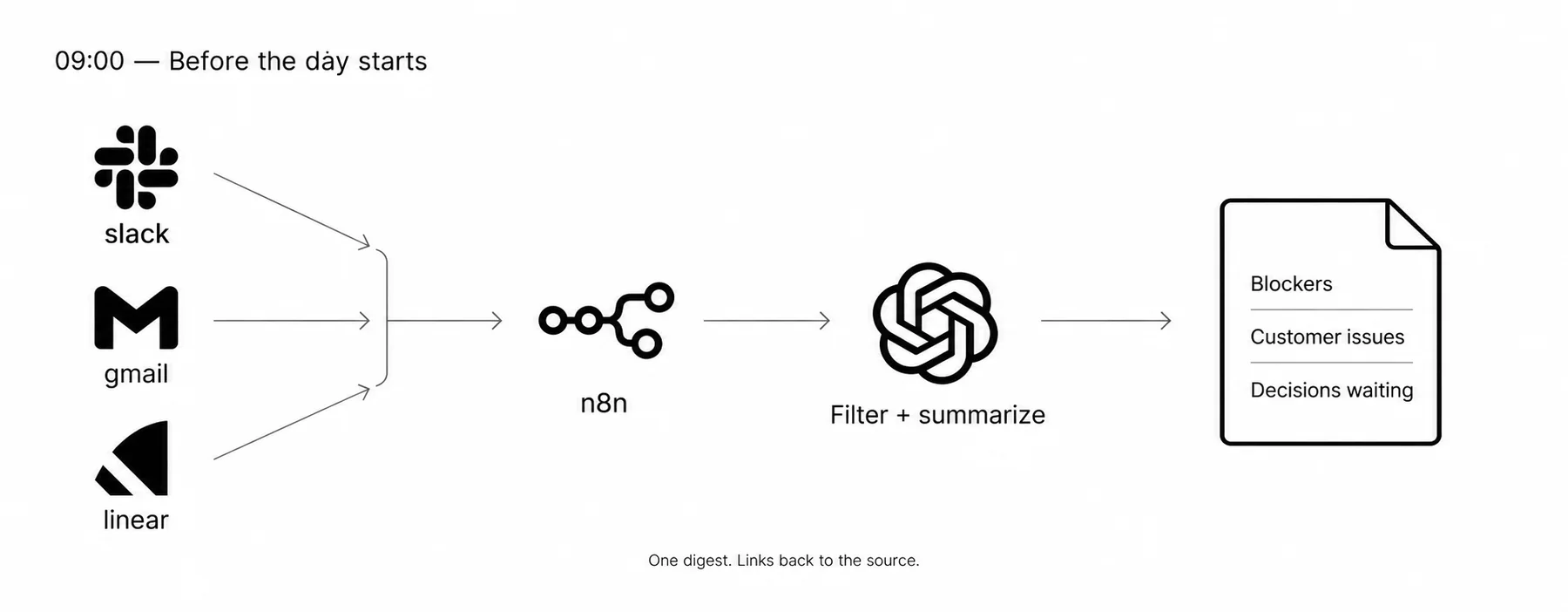
I’d want Slack + Gmail + Linear/Jira → n8n → one digest, and that digest already waiting for me before I properly start working.
Not some enormous AI summary. Just the stuff that can actually affect the day.
Summarize only what can affect product decisions today. Ignore FYI noise. Show blockers, customer issues, decisions already made and questions waiting for me.
So instead of reading 200 messages, I get something like: checkout bug fixed, one customer is pissed, onboarding decision is waiting, sales asked about feature X again.
Good. Next.
10:00-10:45 - backlogs
Now we have roadmap stuff, tasks, maybe a pile of feedback that somehow multiplied overnight.
I’d use Productboard or Jira Product Discovery, but I really don’t want to manually copy every support ticket or customer comment into it.
Support, interview notes, sales notes etc can go through n8n first and get attached to existing roadmap items if there is a clear match.
What I actually want AI to do here is not “prioritize my roadmap for me”. I want it to show where we have actual evidence and where we kinda made something up because one stakeholder mentioned it three times.
And for Linear/Jira, same thing. Let AI enrich the task a bit, mark duplicates, missing info, rough customer impact. If there isn’t enough evidence, I’d force it to write UNKNOWN.
Otherwise every stupid task somehow becomes strategically important.
10:45-11:15 - we’ve saved plenty of time. Might as well have a second breakfast with some YouTube on the background
Honestly yeah.
If the morning digest and backlog cleanup saved you 40 minutes, please don’t immediately fill those 40 minutes with another dashboard.
Second breakfast. YouTube. Coffee if you’re into that. Whatever.
Productivity tools should also give you some life back, not only help you cram more work into the same day.
11:30 ishhh - market research, but not a boring one
I’d automate the repetitive part.
Let’s say I care about 10 competitors. I absolutely don’t want to “research” all 10 every week from zero.
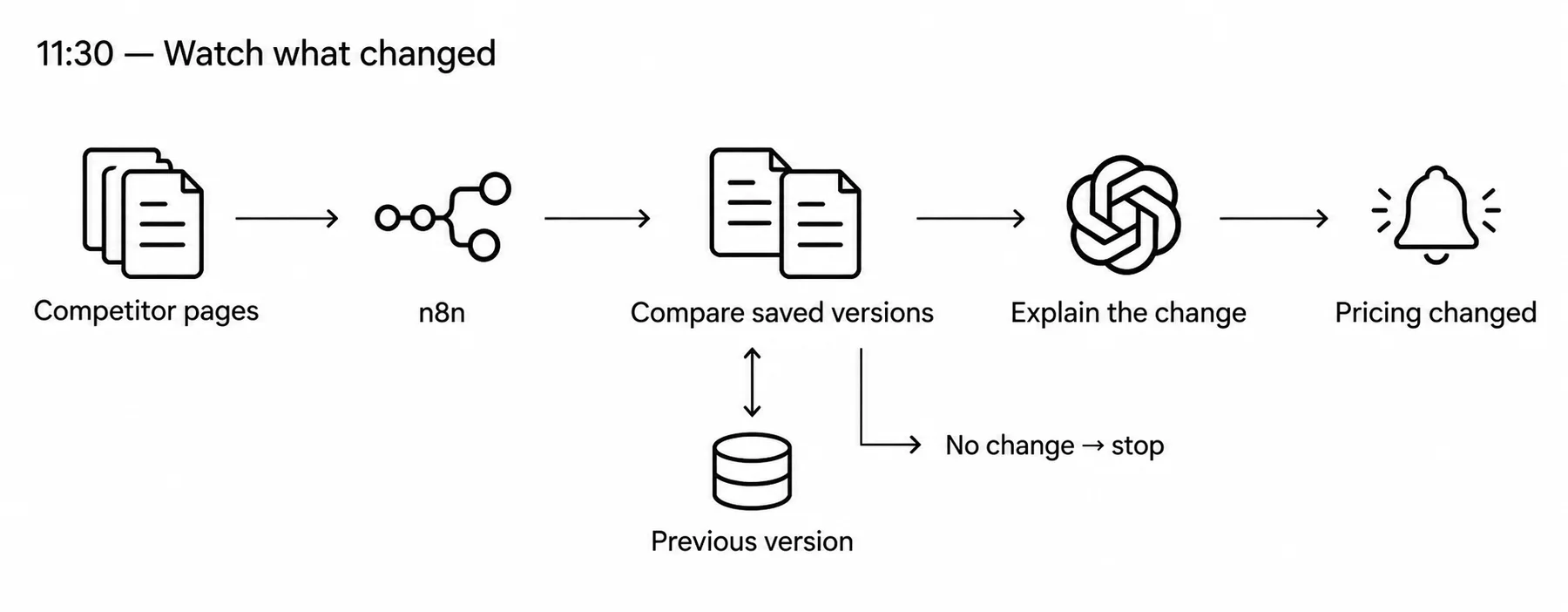
I want their pricing pages, product pages, changelogs, maybe Reddit mentions watched in the background, and then I only get pinged when something actually changed.
competitor pages → n8n → compare with previous version → AI → tell me what materially changed
Maybe pricing changed. Maybe they launched enterprise. Maybe onboarding is suddenly completely different. Maybe they quietly killed a feature.
That’s useful.
A fresh 4 page “competitor overview” every week is not.
12:00-… interviews
I know, not an everyday’s task, but let’s include it for the sake of a REALLY busy day simulation.
I’d still do the actual interview myself obviously. This is one place where I really don’t want to outsource the interesting part.
But afterwards, yeah, I don’t want to spend 30 minutes cleaning notes.
Granola → Dovetail, maybe with a small LLM step in between.
Extract what actually hurt the customer, what workaround they use now and anything they said that contradicts what we currently believe about the product. Keep their actual wording where useful.
I especially like the “contradicts what we believe” part.
Otherwise customer summaries get suspiciously comfortable and somehow confirm everything you already thought.
For this handoff, export or copy the notes into your research repository, or build an approved connector. The arrow doesn’t mean there’s a native Granola–Dovetail integration. Granola’s supported integrations ↗
14:00 - analytics after a few calls
This could be boring and exhaustive just a few years ago. Not now tho. Here’s why.
If something weird happens in Amplitude or Mixpanel, like activation suddenly drops, I don’t really want AI to tell me why.
I want AI to help me figure out what to check first.
So let’s say activation goes from 42% to 31%.
Instead of staring at ten dashboards, I can ask it to suggest which segments are worth checking first based on the actual data available.
Traffic source. Device. Geography. Recent release. Whatever is relevant.
The source of truth is still the analytics.
AI just helps me get to the interesting part faster.
15:00 - PRD
Okay okay, definitely not an everyday task, but hey, busy day remember?
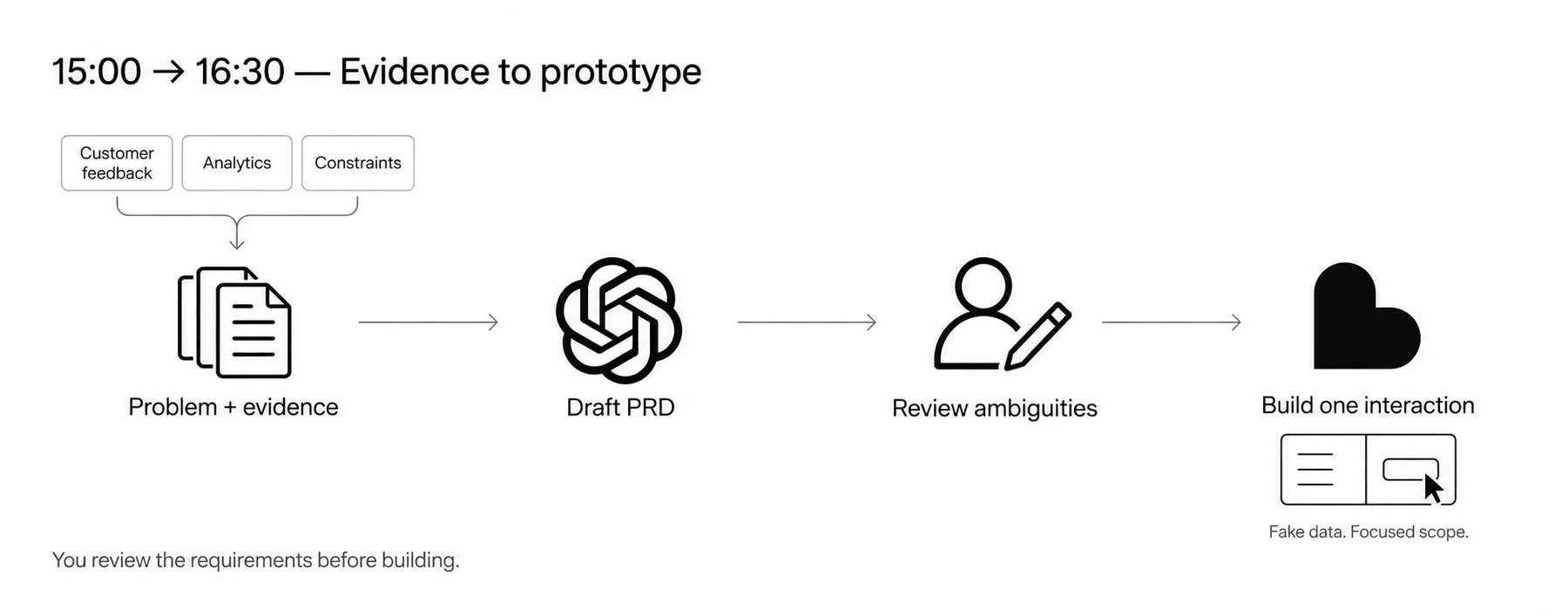
This is where I’d use Claude or ChatGPT, but with the context already pulled in from the roadmap item, analytics and customer feedback.
Not:
write me a PRD for feature X
because that’s how you get three pages of beautiful nothing.
More like:
Here is the customer problem, analytics and engineering constraints. Draft the PRD only from this. Do not invent requirements. Mark assumptions clearly.
And then:
Read this as an engineer. What is unclear or can be interpreted in two different ways?
I usually like the second question more than the first.
16:30 - prototyping time
The whole fun of the day.
Personally, I adore prototyping, and nowadays with AI it’s just a pure joy.
This is where I’d open Lovable, Replit or v0 and just build the damn thing.
Fake data is fine. Half working is fine. If the whole point is to show one interaction to design, engineering or a customer, you don’t need the whole app.
Build a simple clickable prototype for this workflow: [WORKFLOW]. Use fake data. Focus only on the main interaction. Do not add random extra features.
Honestly, sometimes explaining the idea for 40 minutes is just worse than building something ugly in 20.
End of the day - some final notes, reminders, scheduling
I’d automate this part too, but keep it short.
Pull together today’s decisions, new tasks, interview notes, maybe analytics changes, and ask:
What did we actually learn today? What assumptions got stronger, what got weaker and what decisions should still NOT be made?
Then save that somewhere useful, maybe Notion, maybe your product log, maybe just a private daily note.
And if there are follow ups, schedule them while they’re still fresh.
That’s kinda the version of AI for PMs I actually like.
Not “AI does product management for you”.
More like: all the boring transport of information, cleaning, grouping and first pass analysis happens in the background, while you keep the parts where your judgement actually matters.