
1. Love your product.
Mind you, it doesn’t have to be perfect. It might be flawed, it might not be on par with its competitors. But it’s kind of like unconditional love that creates the whole magic.
See the best thing about your product and build the whole perception of it around that fact, in your own mind first.
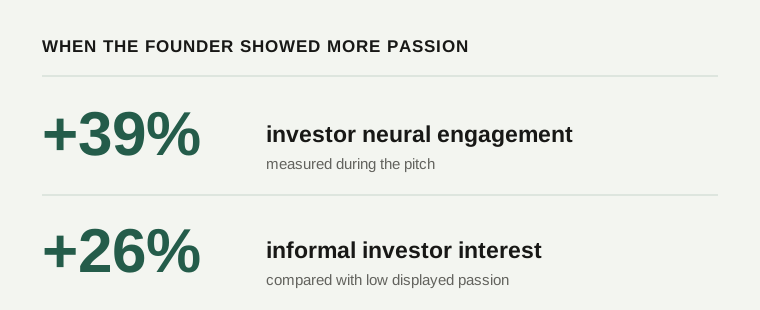
2. Don’t have a big team? Then don’t be a d*ck, you are the face of the product.
In fact, treat the product as your mirror.
If you find it hard to socialize and the majority of people genuinely dislike you, you’ve gotta work on the root cause first.
You can try to fake your personality to sell your product, but at some point your actual personality will show up in the product one way or another.
People feel you through your product.
Related research: founder narrative authenticity and brand attachment; brand consistency, congruency, and trust in 285 SMEs.
3. Be trustworthy.
People contact, and consequently buy from, those they trust.
The rule here is the same as in #2: you have to actually be trustworthy, not just fake it.
Examples?
Don’t overpromise.
Don’t disappear mid-conversation.
Don’t try to sneakily change the conditions you’ve already discussed.
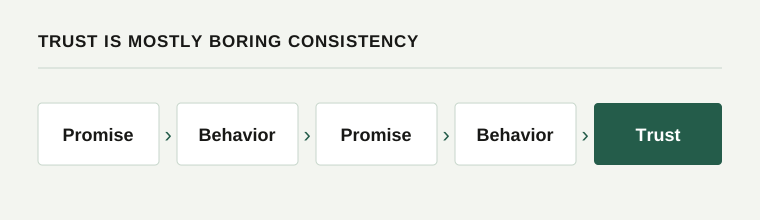
Trust is mostly boring consistency.
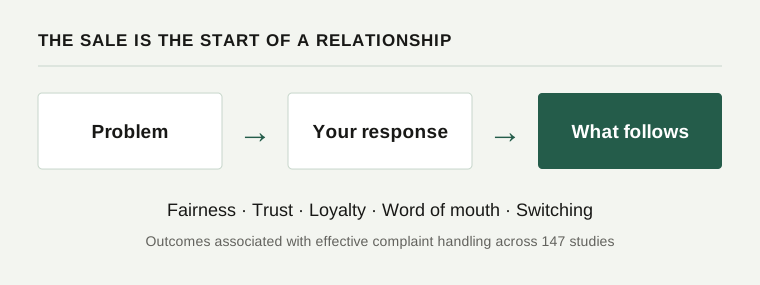
4. Selling something is only one half of the business.
You’ve gotta commit to your customers.
If someone purchased your product, even if it’s NOT a subscription, don’t just leave them hanging when they contact you with questions, problems, etc.
That’s something a lot of people seriously overlook, and then they end up with tons of negativity on Reddit, Trustpilot, and you name it.
Getting the money isn’t the end of the relationship.
5. Be curious.
You don’t sell to abstract entities. You sell to people, even if it’s B2B.
Learn to be genuinely curious about people, learn to WANT to ask questions, figure out their problems, wishes etc.
The last thing you want is that awkward situation where you’ve managed to forcibly sell something to an already-frustrated customer.
It can take a ridiculous amount of effort to rebuild your image with that customer afterward. You don’t want this to happen, trust me.
Yeah, I’ve done it. It’s cringe-inducing for life.
Also, as you can see, this point is related to #2, #3 and #4, and might look contradictory to #1.
Yeah, love your product.
Just don’t let that love make you put Cinderella’s glass slipper on a basketball player.
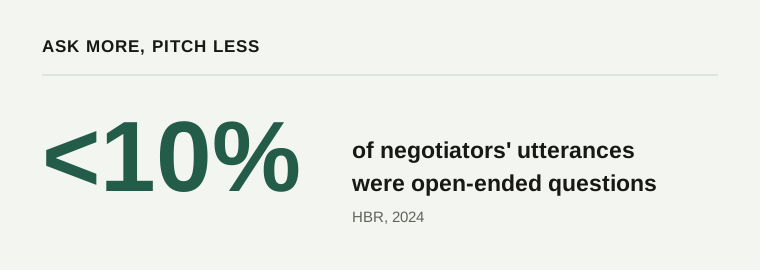
Further reading: question-asking and liking; listening and sales outcomes; and open-ended questions in negotiation (fewer than 10% of negotiators' utterances in the study).